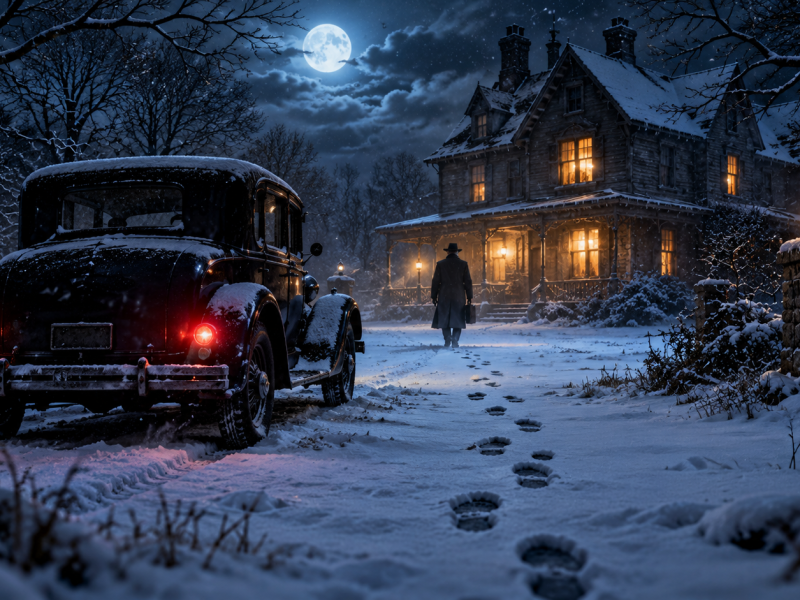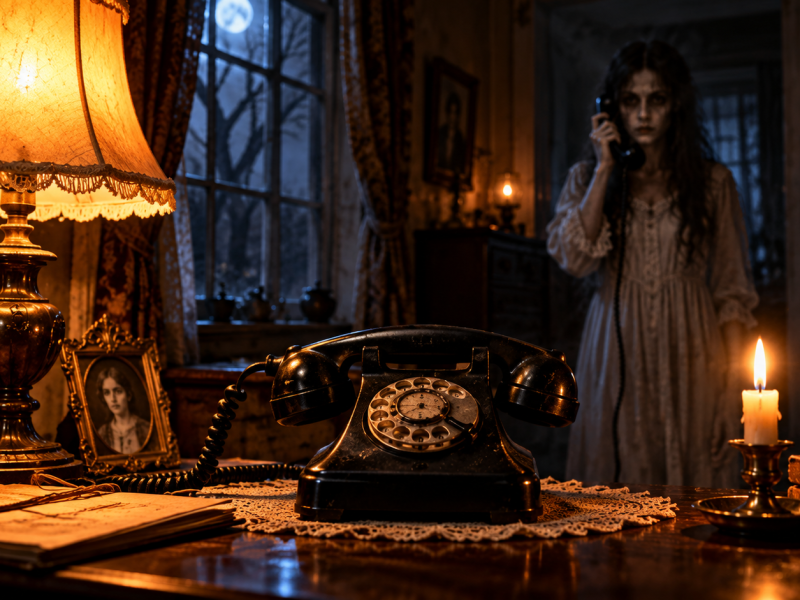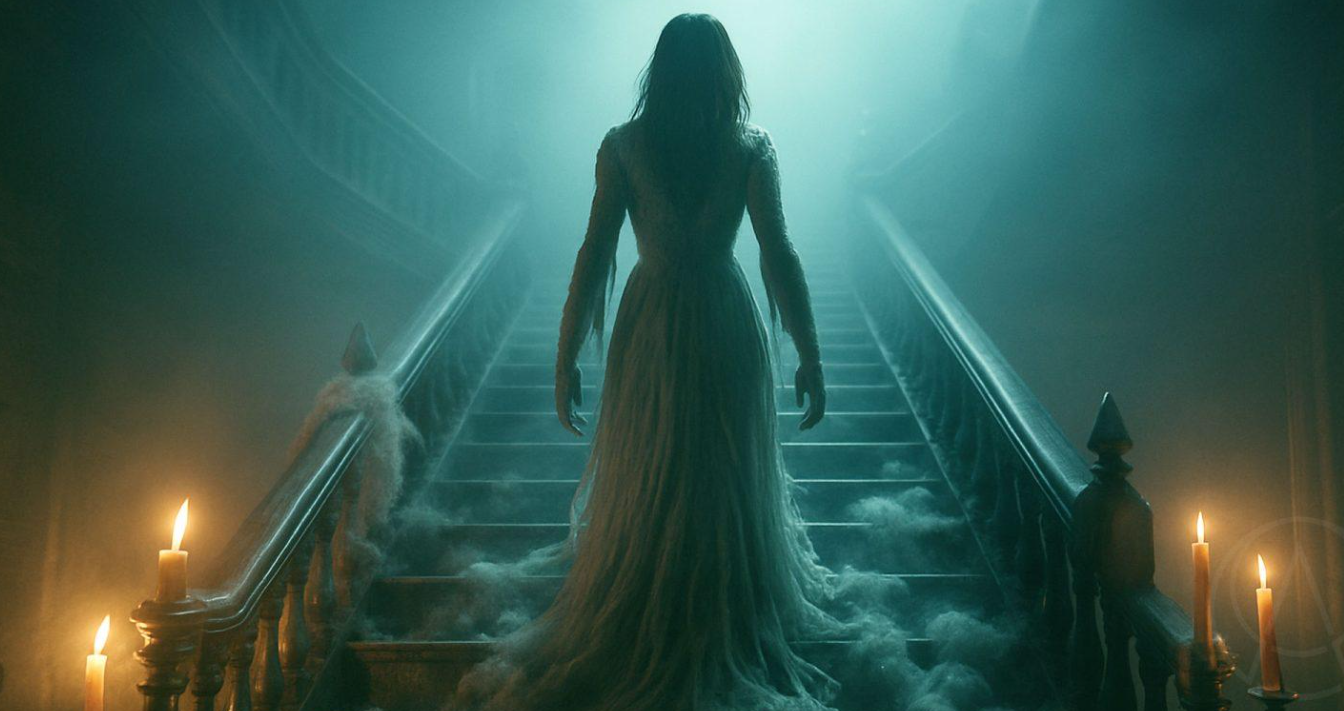
For seventy-three years, the old mansion on Raven Hill stood abandoned. Its windows were boarded shut, its gardens had turned wild, and the villagers refused to walk past its gates after sunset. But when a young woman inherited the property, she discovered something far more terrifying than a haunted house. Every night at 3:13 a.m., a woman in a white dress appeared on the staircase—and every morning, she stood one step closer to the front door.
An original fictional vintage horror story inspired by the atmosphere of Victorian ghost legends.
Chapter 1: The Mansion Nobody Wanted
In October 1924, twenty-eight-year-old Margaret Ellis received a letter that would change her life forever.
It arrived on a cold Tuesday morning, sealed with dark red wax.
The letter informed her that a distant relative, Mrs. Adelaide Ravenwood, had died and left her an enormous Victorian mansion in the English countryside.
The property was known as Raven Hill House.
Margaret had never heard of it.
She worked as a schoolteacher in London and had spent most of her life struggling to pay rent. The possibility of owning a beautiful country estate seemed almost unbelievable.
There was, however, one unusual condition attached to the inheritance.
The solicitor’s letter stated:
The new owner must remain inside the property for seven consecutive nights before the estate can legally be transferred.
Margaret found the requirement strange but harmless.
Seven nights in a mansion seemed a small price to pay for financial security.
She packed her belongings and boarded the afternoon train.
By evening, she reached the village of Blackmere.
When she asked the stationmaster for directions to Raven Hill, his friendly expression disappeared.
“You’re not planning to stay there, are you, miss?”
“Actually, I’ve inherited the house.”
The elderly man slowly removed his cap.
“Then I suggest you leave before nightfall.”
Margaret laughed nervously.
“Is the house dangerous?”
The stationmaster looked toward the darkening hills.
“Not during the day.”
Chapter 2: The Woman in the Upstairs Window
Raven Hill House stood at the end of a narrow road surrounded by enormous oak trees.
Its black iron gates hung crookedly from stone pillars.
The gardens had become a wilderness of tangled vines and dead roses.
The mansion itself was magnificent, although years of neglect had left its walls cracked and its windows coated with dust.
Margaret pushed open the heavy front door.
A cold draft rushed through the entrance hall.
Inside, a grand wooden staircase curved toward the second floor.
Above it hung an enormous chandelier covered in cobwebs.
The house smelled of damp wood, old books, and something faintly sweet.
Almost like lavender perfume.
Margaret explored the ground floor, discovering a library, dining room, music room, and several beautifully furnished bedrooms.
Everything appeared strangely untouched.
The clocks had stopped.
The furniture remained covered with white sheets.
And every mirror had been turned toward the wall.
As evening approached, Margaret stepped outside to collect her luggage.
She glanced toward the upstairs windows.
A woman stood behind the glass.
She wore a long white nightdress.
Her black hair fell over her face.
Margaret froze.
“Hello?” she called.
The woman did not move.
Margaret hurried back inside and climbed the stairs.
But when she reached the bedroom, it was empty.
The window was locked from the inside.
And on the dusty floor, a single set of wet footprints led from the window toward the bedroom door.
Chapter 3: The First Night at Raven Hill
Margaret chose a bedroom near the staircase.
She lit two candles, placed her suitcase beside the bed, and tried to convince herself that the woman in the window had been an illusion.
Outside, rain began tapping against the glass.
At midnight, the house became unusually quiet.
Even the wind seemed to stop.
Margaret was almost asleep when she heard footsteps.
Slow.
Heavy.
Deliberate.
They came from the staircase.
Step.
Step.
Step.
Margaret opened her eyes.
The footsteps stopped.
She listened carefully.
Nothing.
Then a woman’s voice whispered from the hallway.
“Margaret.”
Her heart began pounding.
“Who’s there?”
No answer.
She climbed out of bed and opened the door.
The corridor was empty.
But at the far end, the staircase was illuminated by a strange blue light.
A woman stood on the top step.
Long black hair covered her face.
Her white nightdress hung loosely around her body.
She was barefoot.
Margaret couldn’t move.
The woman slowly raised one hand and pointed toward the front door.
Then she whispered:
“Don’t let him in.”
The grandfather clock downstairs struck three.
Margaret looked toward it.
The hands showed 3:13 a.m.
When she looked back, the woman was gone.
Chapter 4: The Diary Beneath the Floorboards
The following morning, Margaret searched the mansion for an explanation.
In the library, she discovered several dusty photograph albums belonging to the Ravenwood family.
Most contained portraits of wealthy gentlemen, elegant women, and children standing in the gardens.
But one photograph caught her attention.
It showed a young woman with long dark hair wearing a white dress.
On the back was written:
Eleanor Ravenwood — 1851.
Margaret recognized the woman immediately.
She was the figure from the staircase.
Beside the photograph lay a small leather diary.
Its pages were yellow and fragile.
Margaret opened it carefully.
The first entries described an ordinary life filled with garden parties, family dinners, and music.
But the later entries became increasingly disturbing.
September 14, 1851.
Father has forbidden me from entering the cellar. He says the noises are caused by old pipes, but pipes do not whisper people’s names.
September 19.
Mother says I must stop asking questions. Last night, I heard someone knocking beneath the dining room floor.
September 23.
There is a man standing outside my bedroom every night. He has no face. I can hear him breathing through the keyhole.
Margaret turned another page.
The handwriting had become shaky.
October 1.
The house is not haunted by the dead.
It is waiting for the living.
The final entry contained only five words.
Never open the seventh door.
Chapter 5: The Seven Doors
Margaret spent the afternoon exploring the second floor.
There were six bedrooms arranged along the main corridor.
Each had a heavy wooden door.
But according to the original architectural plans she discovered in the library, there should have been seven.
The seventh room appeared on the plans at the far end of the hallway.
Yet that section of the corridor ended in a solid wall.
Margaret examined the wallpaper.
A faint rectangular outline was visible beneath the faded pattern.
She pressed her hand against it.
The wall sounded hollow.
Using a fireplace tool, she carefully loosened the wooden paneling.
Behind it was a narrow black door.
Seven deep scratches marked its surface.
There was no handle.
Only a small brass keyhole.
Margaret stepped backward.
A cold whisper drifted from the other side.
“Margaret.”
She recognized the voice.
It was Eleanor.
“Please,” the voice continued. “Open it.”
Margaret remembered the warning from the staircase.
Don’t let him in.
She turned and hurried away.
Behind her, something knocked three times against the hidden door.
Then it began laughing.
Chapter 6: The Second Night — Something Came Downstairs
That evening, Margaret locked herself inside her bedroom.
She placed a chair beneath the door handle and kept every candle burning.
At 3:13 a.m., the footsteps returned.
But this time, they sounded different.
There were two sets.
One belonged to someone walking slowly down the staircase.
The other sounded like bare feet dragging across the wooden floor.
Margaret pressed her ear against the door.
A woman’s voice whispered:
“He’s getting closer.”
Then a deep male voice answered:
“She has the house now.”
Margaret covered her mouth.
The bedroom handle began turning.
Slowly.
Back and forth.
The chair scraped across the floor.
A shadow appeared beneath the door.
It was impossibly tall.
The shadow stretched across the room, reaching the foot of Margaret’s bed.
Then the candles went out.
In the darkness, something whispered directly beside her ear.
“Six nights left.”
Margaret screamed.
When daylight finally entered the room, the chair was still beneath the door handle.
The door remained locked.
But written across the inside of the bedroom door were three words.
HE KNOWS YOU.
Chapter 7: The Village’s Darkest Secret
Margaret fled to Blackmere the next morning.
She visited the oldest resident in the village, a retired doctor named Samuel Whitmore.
When she mentioned Raven Hill, his face turned pale.
“You should never have gone there,” he said.
Margaret showed him Eleanor’s photograph and described the woman on the staircase.
The doctor listened without interrupting.
Then he opened an old wooden cabinet and removed a newspaper dated October 1851.
Its headline read:
RAVENWOOD FAMILY VANISHES FROM COUNTRY ESTATE.
The article described how the entire Ravenwood household had disappeared overnight.
Nine family members.
Four servants.
Not a single body had been discovered.
The doors had been locked from the inside.
Food remained on the dining table.
The fireplace was still burning.
And the grandfather clock had stopped at 3:13 a.m.
Margaret stared at the newspaper.
“What happened to them?”
The doctor lowered his voice.
“Nobody knows. But the house has belonged to several families since then.”
“And?”
“Every family that stayed longer than six nights disappeared.”
Margaret felt sick.
“Why didn’t anyone tell me?”
The doctor looked away.
“Because the house chooses who inherits it.”
Chapter 8: The Photograph That Changed Overnight
Margaret returned to the mansion only because her suitcase, money, and legal documents were still inside.
She planned to collect everything and leave before sunset.
But when she entered the library, she noticed that Eleanor’s photograph had changed.
The woman was no longer standing alone.
A second figure appeared beside her.
It was Margaret.
Wearing the same blue dress she had worn the previous day.
Her eyes were closed.
And behind both women stood a tall man dressed in black.
His face was blurred.
Margaret dropped the photograph.
At that moment, the library door slammed shut.
The grandfather clock began ticking.
Its hands moved rapidly backward.
1924.
1901.
1875.
1851.
The room darkened.
When Margaret looked through the window, the overgrown garden had disappeared.
Outside stood beautifully trimmed hedges and carriages waiting beside the entrance.
She heard music.
Laughter.
The sound of a dinner party.
The house had somehow returned to the past.
Chapter 9: The Man Without a Face
Margaret stepped into the hallway.
The mansion was filled with people wearing Victorian clothing.
They moved around her without acknowledging her presence.
A young Eleanor stood beside the staircase, arguing with an elderly gentleman.
“Father, you cannot keep it down there forever!”
The man grabbed her wrist.
“You do not understand what we have invited into this house.”
Suddenly, the music stopped.
Every guest turned toward the front door.
Three knocks echoed through the entrance hall.
Knock.
Knock.
Knock.
A servant approached the door.
Eleanor screamed.
“Don’t open it!”
But the servant had already turned the handle.
The door swung inward.
A tall figure stood outside.
He wore a black coat and an old-fashioned hat.
Where his face should have been, there was only darkness.
The guests began backing away.
The figure stepped inside.
And every candle in the mansion went out.
Margaret heard screaming.
Then the entire scene vanished.
She was standing in the abandoned hallway again.
Alone.
Except for Eleanor.
The woman in white stood on the staircase.
Her face was pale.
Her eyes were filled with tears.
“Now you know,” she whispered.
Chapter 10: The Truth Behind the Seventh Door
Eleanor explained that her father had become obsessed with communicating with the dead.
After losing his youngest son to illness, he had invited a mysterious stranger to Raven Hill.
The stranger promised to return the child.
But the ritual required a room that would never be opened after midnight.
The seventh room.
On the final night, Eleanor’s father broke the agreement.
He opened the door.
Something entered the mansion.
It did not kill the family.
It trapped them.
Their memories, voices, and shadows became part of the house.
And every new family that stayed seven nights gave the thing inside another chance to escape.
“Why did you warn me?” Margaret asked.
Eleanor looked toward the sealed door.
“Because I remember what it feels like to be alive.”
“How do I stop it?”
Eleanor reached into her dress and produced a small brass key.
“The house must lose what keeps it alive.”
“What is that?”
“The clock.”
Margaret looked downstairs.
The grandfather clock was ticking louder than ever.
Its hands approached 3:13.
Chapter 11: The Night the House Began to Breathe
Margaret raced down the staircase.
The mansion trembled around her.
The wallpaper began peeling from the walls.
Doors slammed open and shut.
Voices called her name from every room.
At the bottom of the stairs, the grandfather clock stood against the wall.
Its pendulum swung violently.
Margaret opened the glass panel.
Inside, instead of ordinary machinery, she found a small brass compartment.
The key Eleanor had given her fit perfectly.
She turned it.
The clock stopped.
For one second, the entire house became silent.
Then a deep voice thundered from upstairs.
“YOU CANNOT LEAVE.”
The staircase shook.
A tall shadow appeared at the top.
The man without a face.
He descended slowly.
One step.
Then another.
Margaret pulled the pendulum from the clock.
The shadow screamed.
Its body stretched across the walls like black smoke.
The front door flew open.
Cold night air rushed into the hall.
Margaret ran.
Behind her, the windows shattered.
The mansion groaned as though something enormous were moving inside its walls.
She reached the iron gates just as the grandfather clock struck one final time.
3:13 a.m.
Then Raven Hill House went dark.
Chapter 12: The Last Woman on the Staircase
At sunrise, villagers gathered outside the mansion.
Margaret was found unconscious beside the gates.
She survived.
But the house had changed.
Every window was broken.
The front door hung from its hinges.
And the seventh room had disappeared completely.
When investigators searched the property, they discovered old family portraits scattered across the floor.
Each portrait showed the Ravenwood family.
But now, every face had been erased.
Except Eleanor’s.
In her portrait, she stood smiling beside a window filled with sunlight.
Margaret kept the photograph.
She never returned to Raven Hill.
Years later, she married, raised a family, and moved to a peaceful cottage near the sea.
For a long time, she believed the nightmare had ended.
Until one winter evening.
Her youngest daughter came downstairs holding an old photograph.
“Mother,” the little girl asked, “who is the lady in the white dress?”
Margaret froze.
“Where did you find that?”
“In your bedroom.”
The child pointed toward the hallway.
“She says she knows you.”
Margaret slowly turned.
At the bottom of the staircase stood Eleanor.
Her white dress was clean.
Her dark hair no longer covered her face.
She smiled gently.
“Thank you,” she whispered.
Then she disappeared.
Margaret began to cry.
For the first time, she understood.
Eleanor had not come to haunt her.
She had come to say goodbye.
The Ending: Raven Hill Never Truly Died
Raven Hill House was demolished in 1931.
The villagers believed its destruction had finally ended the curse.
The land remained empty for decades.
No one wanted to build on it.
But in 1968, construction workers began digging foundations for a new country hotel.
Three feet beneath the ground, they discovered an old brass clock face.
Its hands were frozen at 3:13.
Beside it lay a small wooden sign.
The words were barely visible.
ROOM SEVEN.
That night, the construction foreman reported hearing footsteps coming from beneath the unfinished foundations.
He also claimed to see a woman in white standing among the trees.
The next morning, the entire construction crew refused to return.
The hotel was never completed.
And even today, according to the legend, travelers passing Raven Hill after midnight sometimes notice a single light glowing where the mansion once stood.
Those who stop to investigate hear a grandfather clock ticking.
Then three knocks.
And finally, a woman’s voice whispering from the darkness:
“Please don’t open the door.”
The End.