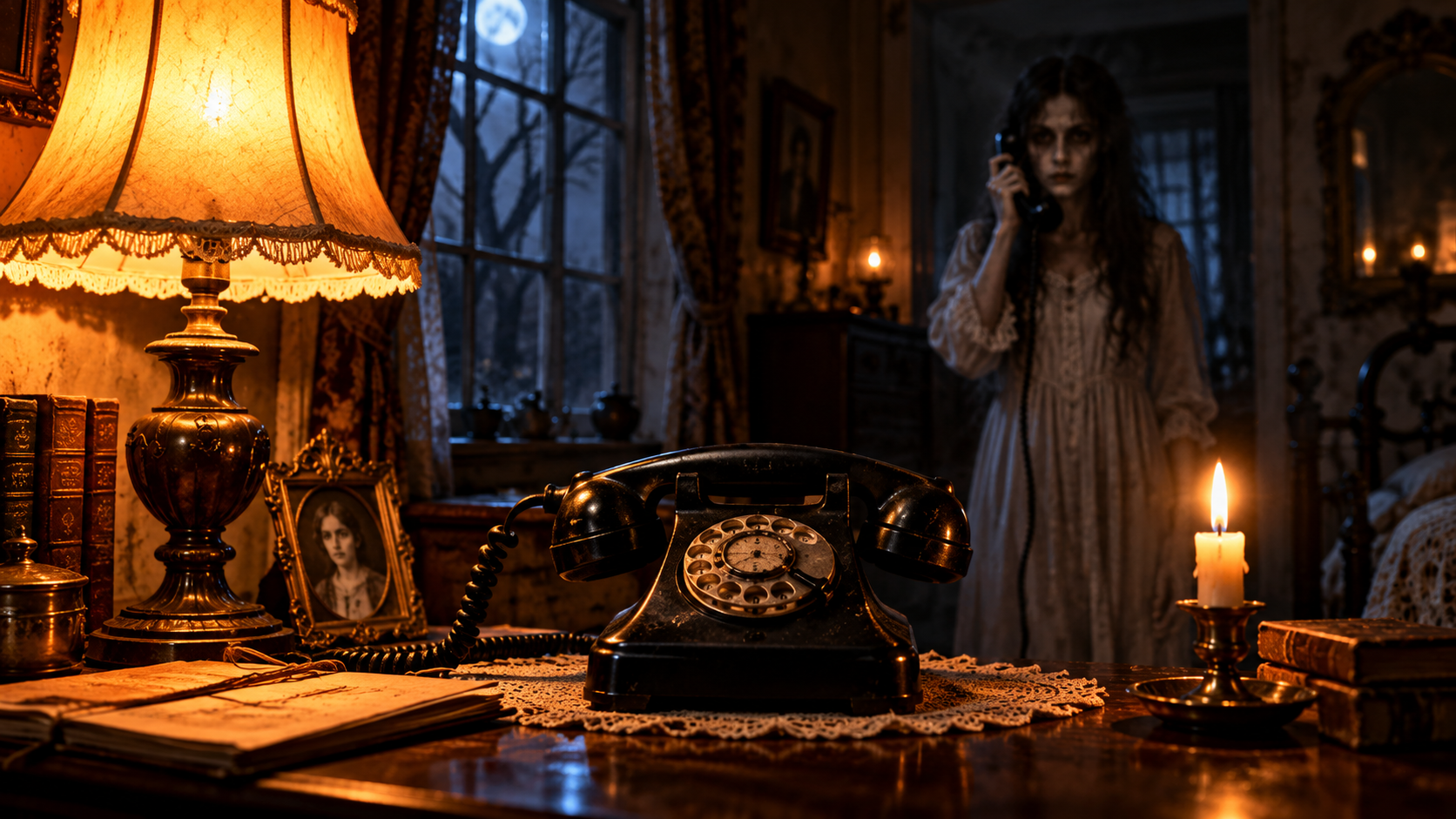
At exactly 11:47 every night, the telephone rang. The woman on the other end knew everything that would happen tomorrow. But one night, she whispered: “Don’t answer the next call. It will be from yourself.”
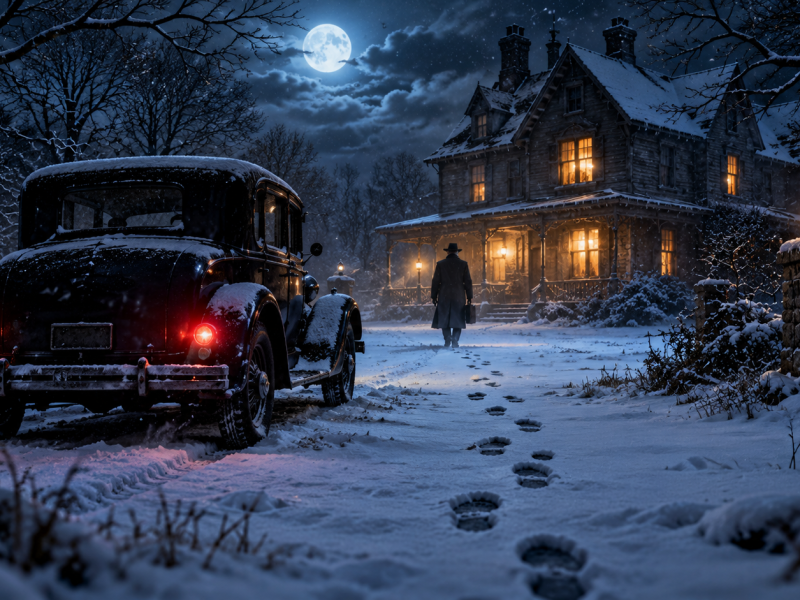
In the autumn of 1936, a young widow named Eleanor Hayes moved into an old Victorian house in the quiet English village of Ashbourne.
The house was beautiful but strangely isolated, surrounded by tall trees and a garden filled with dying roses.
Inside the sitting room stood an antique black telephone.
Its brass dial was worn, its receiver unusually heavy, and its cord disappeared into the wall behind an old wooden cabinet.
The estate agent assured Eleanor that the telephone had been disconnected for nearly twenty years.
But on her first night in the house, at exactly 11:47 p.m., it rang.
And when Eleanor answered, she heard a voice she had not heard in seven years.
Her dead sister’s voice.
“Eleanor, listen carefully. Tomorrow, someone is going to die.”
Chapter 1: The First Telephone Call
Eleanor stood motionless beside the telephone.
Her younger sister, Margaret, had died in a railway accident in 1929.
Eleanor had attended the funeral herself.
She remembered the cold November rain, the black umbrellas, and the sound of earth falling onto the coffin.
Yet the voice on the telephone was unmistakable.
“Margaret?”
A faint crackling sound filled the receiver.
“Eleanor, please don’t hang up.”
Eleanor gripped the telephone tightly.
“This isn’t possible.”
“I know,” Margaret whispered.
“But you must listen.”
Eleanor’s heart pounded.
“Where are you?”
There was a long silence.
Then Margaret answered:
“Yesterday.”
Eleanor frowned.
“What?”
“I’m calling from yesterday.”
The line hissed.
“Tomorrow morning, the baker’s delivery cart will overturn near St. Andrew’s Bridge. A man named Thomas Reed will be killed.”
Eleanor struggled to breathe.
“Why are you telling me this?”
“Because you can stop it.”
Before Eleanor could ask another question, the line went dead.
She stood in the dark sitting room, staring at the telephone.
Then she noticed something strange.
The grandfather clock had stopped.
Its hands pointed to 11:47.
Chapter 2: The Accident That Never Happened
The following morning, Eleanor hurried toward St. Andrew’s Bridge.
She told herself the telephone call had been a dream.
Perhaps grief had finally begun playing tricks on her mind.
But at 9:15 a.m., she saw a delivery cart approaching the bridge.
A young man sat behind the reins.
On the side of the cart were painted the words:
THOMAS REED — BAKERY DELIVERIES
Eleanor froze.
The horse suddenly stumbled.
One wheel struck a loose stone.
The cart tilted dangerously toward the edge of the bridge.
Eleanor screamed.
“Stop!”
Thomas pulled hard on the reins.
The horse reared.
The cart came to a halt inches from the broken railing.
Thomas climbed down, trembling.
“Good heavens, miss! You saved my life.”
Eleanor could barely speak.
She looked at the bridge.
At the damaged railing.
At the cart.
Everything Margaret had predicted was true.
That evening, Eleanor returned home feeling strangely hopeful.
If Margaret could call from the past, perhaps there was a way to speak to her again.
Perhaps even to change what had happened seven years earlier.
At exactly 11:47 p.m., the telephone rang.
Chapter 3: The Voice That Knew Tomorrow
Eleanor answered immediately.
“Margaret?”
“Hello, Eleanor.”
Tears filled her eyes.
“Is it really you?”
“Yes.”
“How can you be calling me?”
Margaret hesitated.
“The telephone doesn’t connect places. It connects moments.”
Eleanor sat down.
“What does that mean?”
“Some moments never end. They remain somewhere, waiting to be heard.”
Eleanor looked toward the dark hallway.
“Are you alive?”
A long silence followed.
Then Margaret whispered:
“Not where you are.”
Eleanor closed her eyes.
“Can I save you?”
The telephone crackled violently.
“Don’t ask me that.”
“Margaret, please.”
“Eleanor, there are things you must never change.”
The line hissed.
Then Margaret spoke again.
“Tomorrow, a little boy will fall through the ice at Miller’s Pond. You must be there before noon.”
Eleanor wiped away her tears.
“I’ll go.”
“Good.”
Then Margaret’s voice became strangely urgent.
“And Eleanor?”
“Yes?”
“If the telephone rings before 11:47, do not answer.”
The line went dead.
Chapter 4: The Boy at Miller’s Pond
The next day, Eleanor went to Miller’s Pond.
The winter had arrived early, and a thin layer of ice covered the water.
At eleven forty-five, she saw a young boy walking near the frozen edge.
He wore a brown coat and carried a wooden toy boat.
Eleanor hurried toward him.
“Stay away from the water!”
The boy stopped.
At that moment, the ice cracked beneath his feet.
He stumbled.
Eleanor grabbed his arm and pulled him backward.
The ice broke apart.
Dark water rose through the opening.
The boy began crying.
Eleanor held him tightly.
“It’s all right. You’re safe.”
His mother arrived moments later.
She thanked Eleanor repeatedly.
But as Eleanor walked home, she began to feel uneasy.
Margaret had saved two lives.
Yet why was she choosing these particular people?
And why did every warning come exactly one day before the event?
That night, Eleanor waited beside the telephone.
At 11:46 p.m., the room grew cold.
The grandfather clock stopped ticking.
Then the telephone rang.
One minute early.
Eleanor stared at it.
Margaret’s warning echoed in her mind.
If the telephone rings before 11:47, do not answer.
The ringing continued.
Then stopped.
A few seconds later, someone knocked on the sitting-room door.
Three slow knocks.
And from the other side came Margaret’s voice.
“Eleanor, why didn’t you answer?”
Chapter 5: The Woman Behind the Door
Eleanor backed away from the door.
“Margaret?”
The voice answered immediately.
“Please open the door.”
Eleanor’s hands trembled.
“How did you get here?”
A pause.
“Through the telephone.”
Eleanor stared at the black receiver.
It rested silently in its cradle.
The voice continued.
“I’ve been waiting so long to see you.”
Tears filled Eleanor’s eyes.
She took one step toward the door.
Then she remembered something.
Margaret had warned her not to answer an early call.
Perhaps the warning applied to more than the telephone.
Eleanor whispered:
“What did Mother call us when we were little?”
Silence.
Then the voice replied:
“Her beautiful girls.”
Eleanor froze.
That was wrong.
Their mother had always called them her little sparrows.
The doorknob slowly turned.
The voice changed.
It became deeper.
Colder.
“Open the door, Eleanor.”
She stepped backward.
The knocking grew louder.
Then came a terrible whisper.
“You cannot keep yesterday outside forever.”
At exactly 11:47, the telephone rang again.
The knocking stopped.
Eleanor rushed to the receiver.
Margaret’s voice came through.
“Did you open the door?”
“No.”
“Thank God.”
“Margaret, what was that?”
A long silence followed.
Then her sister whispered:
“Something that learned my voice.”
Chapter 6: The House With Two Histories
The following morning, Eleanor visited the village records office.
She wanted to learn more about the house.
The clerk, an elderly man named Mr. Whitcomb, searched through several dusty ledgers.
Finally, he found an old property register.
“The house was built in 1879,” he explained.
“It belonged to a telephone engineer named Henry Blackwood.”
Eleanor leaned forward.
“What happened to him?”
Mr. Whitcomb hesitated.
“He disappeared.”
“When?”
“November 14, 1917.”
Eleanor felt a chill.
“Was there anything unusual about his disappearance?”
The clerk removed an old newspaper clipping.
The headline read:
ENGINEER VANISHES AFTER CLAIMING TO RECEIVE CALLS FROM THE FUTURE
According to the article, Blackwood had been experimenting with unusual electrical equipment.
He believed certain frequencies could carry voices through time.
His wife had died in 1916.
After her death, he claimed she began calling him on an experimental telephone.
At first, the calls contained harmless information.
Weather predictions.
Train schedules.
Names of visitors who would arrive the next day.
But eventually, the calls became disturbing.
Blackwood claimed the voice on the telephone had begun asking him to change events.
To prevent accidents.
To save strangers.
To alter the future.
Then one evening, he disappeared.
The final entry in his notebook contained only one sentence.
EVERY LIFE SAVED GIVES IT ANOTHER MINUTE.
Eleanor read the words again.
Another minute.
She remembered Thomas Reed.
The boy at Miller’s Pond.
Two lives saved.
Two moments changed.
And the voice behind the door.
Suddenly, she understood.
The telephone was not simply warning her about the future.
Something was using her to change it.
Chapter 7: The Third Warning
That evening, Eleanor waited anxiously for the telephone to ring.
At exactly 11:47, it did.
She answered.
“Margaret, I know about Henry Blackwood.”
Silence.
Then her sister spoke.
“You shouldn’t have looked.”
“Who are you really?”
“Eleanor, please listen.”
“No. Tell me the truth.”
The line crackled.
Margaret began crying.
“I am your sister.”
“Then why are you helping that thing?”
A long silence followed.
Finally, Margaret whispered:
“Because it has me.”
Eleanor closed her eyes.
“What do you mean?”
“When the train crashed in 1929, I didn’t die immediately.”
Eleanor gripped the receiver.
“I was trapped. I remember the darkness. I remember calling your name.”
“Margaret…”
“Something answered me.”
The telephone hissed.
“It promised I could speak to you again.”
Eleanor felt tears running down her cheeks.
“What did it want?”
Margaret’s voice trembled.
“Time.”
Eleanor looked toward the grandfather clock.
Its hands were frozen at 11:47.
Margaret continued.
“Every life you save changes what was supposed to happen. The moments that disappear don’t vanish. They belong to it.”
Eleanor whispered:
“And what happens when it has enough?”
Margaret began sobbing.
“It can come through.”
Chapter 8: The Call From Tomorrow
The following night, the telephone rang at 11:46.
Eleanor did not answer.
It rang again.
And again.
Then the grandfather clock began ticking backward.
The room grew freezing cold.
The wallpaper seemed to darken.
And the telephone rang one final time.
At 11:47.
Eleanor lifted the receiver.
“Margaret?”
A woman’s voice answered.
But it was not Margaret.
It was Eleanor’s own voice.
Older.
Exhausted.
Terrified.
“Don’t speak.”
Eleanor froze.
“Who is this?”
The voice whispered:
“I’m you.”
Eleanor’s heart pounded.
“That’s impossible.”
“I know what you’re thinking. You’re looking at the clock. You’re wondering whether you’ve gone mad.”
Eleanor stared at the grandfather clock.
The voice continued.
“Listen carefully. Tomorrow, the house will burn.”
Eleanor struggled to breathe.
“What?”
“You will try to destroy the telephone.”
“How do you know?”
“Because I already did.”
A terrible silence followed.
Then the older Eleanor whispered:
“And that’s when I discovered the telephone was never connected to the wall.”
Chapter 9: The Wire Beneath the Floor
At dawn, Eleanor moved the wooden cabinet away from the wall.
Behind it, she found the telephone wire.
It disappeared through a small hole in the floorboards.
She followed it into the cellar.
The basement smelled of damp earth and old wood.
A narrow staircase led into darkness.
Eleanor carried a lantern.
The wire ran along the wall.
Then disappeared beneath a locked wooden door.
She forced the lock open.
Inside was a small room.
Its walls were covered with old electrical equipment.
Copper wires hung from the ceiling.
Dozens of broken telephone receivers lay scattered across the floor.
At the centre stood a large wooden cabinet.
Inside was a machine unlike anything Eleanor had ever seen.
Its brass wheels turned slowly.
Its glass tubes glowed with a faint blue light.
And attached to the machine were dozens of telephone lines.
Each line had a label.
A date.
Eleanor examined them.
NOVEMBER 14, 1917
FEBRUARY 3, 1929
OCTOBER 21, 1936
Then she noticed a final label.
NOVEMBER 7, 1936 — ELEANOR HAYES
Her hands began trembling.
That date was tomorrow.
Beneath the label was a handwritten message.
THE LAST CALL MUST BE ANSWERED.
Suddenly, every telephone in the room began ringing.
Chapter 10: The Voices of the Forgotten
Eleanor stumbled backward.
The ringing filled the cellar.
One telephone after another.
Dozens of voices began speaking.
A man begging for help.
A woman crying.
A child calling for his father.
Then Eleanor heard Margaret.
“Eleanor!”
She rushed toward the nearest receiver.
“Margaret!”
“Don’t touch the machine!”
“How do I stop it?”
Margaret’s voice trembled.
“You have to let yesterday end.”
Eleanor looked at the spinning brass wheels.
“What does that mean?”
“Every person who calls through the machine is trapped inside a moment that never finished.”
Eleanor felt sick.
“Can I free them?”
“Yes.”
“How?”
Margaret hesitated.
“Destroy the clock.”
Eleanor frowned.
“What clock?”
“The one upstairs.”
“The grandfather clock?”
“Yes.”
Eleanor remembered how it stopped every night at 11:47.
Margaret continued.
“The clock keeps the doorway open.”
Eleanor turned toward the cellar stairs.
Then another voice came through the receiver.
Deep.
Ancient.
Unnatural.
“SHE IS LYING TO YOU.”
Every telephone stopped ringing.
The brass wheels slowed.
And from somewhere behind Eleanor came the sound of footsteps.
Chapter 11: The Man Who Wasn’t There
A tall man stood in the cellar doorway.
He wore an old-fashioned black suit.
His face was pale.
His eyes were completely dark.
Eleanor backed away.
“Who are you?”
The man smiled.
“Henry Blackwood.”
Eleanor stared.
“You’re dead.”
He shook his head.
“No. I simply ran out of time.”
He stepped into the room.
“I built the machine to speak to my wife.”
Eleanor gripped the lantern.
“And what did you create?”
Blackwood looked toward the telephone wires.
“A door.”
“To where?”
He smiled sadly.
“To the place where unfinished moments go.”
Eleanor felt the room grow colder.
Blackwood continued.
“Your sister is there. So is my wife. So are hundreds of others.”
“Then let them go.”
“I cannot.”
“Why?”
His expression changed.
“Because something came through the door before I could close it.”
The lights flickered.
Blackwood looked frightened.
“It wears the voices of people we love.”
Eleanor whispered:
“The thing behind my door.”
Blackwood nodded.
“And now it knows your voice.”
Chapter 12: The Night the House Burned
At 11:40 p.m., Eleanor carried an axe into the sitting room.
The grandfather clock stood beside the fireplace.
Its pendulum moved slowly.
Tick.
Tock.
Tick.
Tock.
Eleanor raised the axe.
Then the telephone rang.
She froze.
The clock showed 11:46.
The ringing continued.
Eleanor remembered the warning.
Do not answer before 11:47.
She turned toward the clock.
The pendulum stopped.
Then the telephone rang again.
At 11:47.
Eleanor answered.
Her own voice whispered:
“Don’t break the clock.”
Eleanor closed her eyes.
“Why?”
“Because that’s what it wants.”
She stared at the axe.
The voice continued.
“The clock isn’t keeping the doorway open.”
“Then what is?”
A pause.
“You are.”
Eleanor felt her blood turn cold.
“What?”
“Every time you answer the telephone, you give it another piece of your life.”
The room grew darker.
The voice continued.
“You think you’re receiving calls from yesterday.”
“But you’re not.”
Eleanor whispered:
“Then where are the calls coming from?”
The older voice answered:
“From all the tomorrows you will never live.”
Chapter 13: The Final Call
Eleanor dropped the receiver.
The telephone continued speaking.
Voices poured from it.
Margaret.
Henry Blackwood.
Her mother.
Her dead husband.
Then her own voice.
Again and again.
Calling her name.
Eleanor realised what she had to do.
She couldn’t destroy the machine.
She couldn’t break the clock.
She had to stop answering.
She stepped away from the telephone.
The ringing grew louder.
The walls trembled.
The grandfather clock began striking midnight.
One.
Two.
Three.
Then the sitting-room door slowly opened.
A woman stood in the hallway.
She looked exactly like Eleanor.
Same face.
Same hair.
Same white nightdress.
But her eyes were completely black.
The woman smiled.
“Hello, Eleanor.”
Eleanor backed toward the fireplace.
The woman stepped closer.
“You’ve been very helpful.”
Eleanor shook her head.
“No.”
The woman laughed softly.
“You saved two lives.”
She held up two pale fingers.
“Two beautiful little pieces of time.”
Eleanor reached for the axe.
The woman stopped smiling.
“Don’t.”
Eleanor lifted it.
Then struck the telephone.
The black casing shattered.
Sparks flew across the carpet.
The room filled with a terrible scream.
The woman in the hallway began to fade.
But before she disappeared, she whispered:
“You cannot destroy a call that has already been answered.”
The curtains caught fire.
Smoke filled the room.
Eleanor ran toward the front door.
Behind her, the grandfather clock struck thirteen.
Then everything went silent.
Chapter 14: The Morning After
The fire destroyed most of the old house.
Eleanor survived.
The villagers found her unconscious beside the garden gate.
For several weeks, she remained in hospital.
When she recovered, she told the police about the telephone.
They searched the ruins.
But no machine was found in the cellar.
No wires.
No electrical equipment.
Only a small empty room.
The grandfather clock had also vanished.
The police believed Eleanor had suffered a nervous breakdown.
Eventually, she stopped telling the story.
She moved to a small cottage near the coast.
She bought new furniture.
New curtains.
And a new telephone.
But she never answered calls after sunset.
For many years, life remained peaceful.
Then, in the winter of 1951, something happened.
Chapter 15: The Call That Never Ended
Eleanor was now an elderly woman.
Her hair had turned silver.
Her hands trembled slightly when she poured tea.
One evening, she sat beside the fireplace reading a book.
Outside, snow fell silently.
The grandfather clock in the hallway struck eleven.
Then the telephone rang.
Eleanor froze.
She looked at the clock.
11:47 p.m.
Her heart began pounding.
The telephone rang again.
And again.
Finally, Eleanor approached it.
She stared at the receiver.
Fifteen years had passed since the fire.
Surely it was impossible.
The telephone stopped ringing.
Eleanor sighed with relief.
Then a voice came from the receiver.
Although it was still resting in its cradle.
“Eleanor.”
She stepped backward.
It was Margaret.
Her sister.
The same voice.
The same gentle tone.
“Eleanor, please.”
Tears filled her eyes.
“Margaret?”
The voice whispered:
“You never stopped the calls.”
Eleanor shook her head.
“I destroyed the telephone.”
“No.”
A pause.
“You destroyed the wrong one.”
Eleanor looked toward the hallway.
A second telephone stood on a small wooden table.
An antique black telephone.
Its brass dial was worn.
Its receiver was unusually heavy.
And its cord disappeared into the wall.
Eleanor stared in horror.
She had never owned that telephone.
It rang.
Once.
Twice.
Three times.
Then the receiver slowly lifted from its cradle.
A woman’s voice whispered:
“Hello, Eleanor. This is you calling from tomorrow.”
Eleanor could not move.
The voice continued.
“There’s something you need to know.”
A pause.
“Tomorrow, you will die.”
Eleanor closed her eyes.
Then the voice added:
“But don’t worry.”
A soft laugh came through the receiver.
“You’ve already died yesterday.”
The room went dark.
The clock stopped.
And somewhere beyond the walls, hundreds of telephones began ringing.
The following morning, the villagers found Eleanor’s cottage empty.
The fire was still burning in the fireplace.
Her tea was still warm.
And on the table lay a newspaper dated November 7, 1936.
The headline read:
LOCAL WOMAN DIES IN MYSTERIOUS HOUSE FIRE
Beneath it was a photograph.
Eleanor Hayes.
Age twenty-nine.
The woman who had supposedly survived the fire fifteen years earlier.
But the strangest discovery was made by the telephone engineer who arrived to disconnect the line.
He found that the cottage had no active telephone connection.
In fact, according to the records, it never had.
Yet when he lifted the receiver, he heard a woman whisper:
“Hello?”
He froze.
The voice continued.
“Please listen carefully.”
A pause.
“Tomorrow, someone is going to die.”
And the grandfather clock struck 11:47.
THE END
An original vintage supernatural horror story about a disconnected telephone, a voice from the past, a woman who tries to change tomorrow, and the terrifying possibility that yesterday never truly ends.