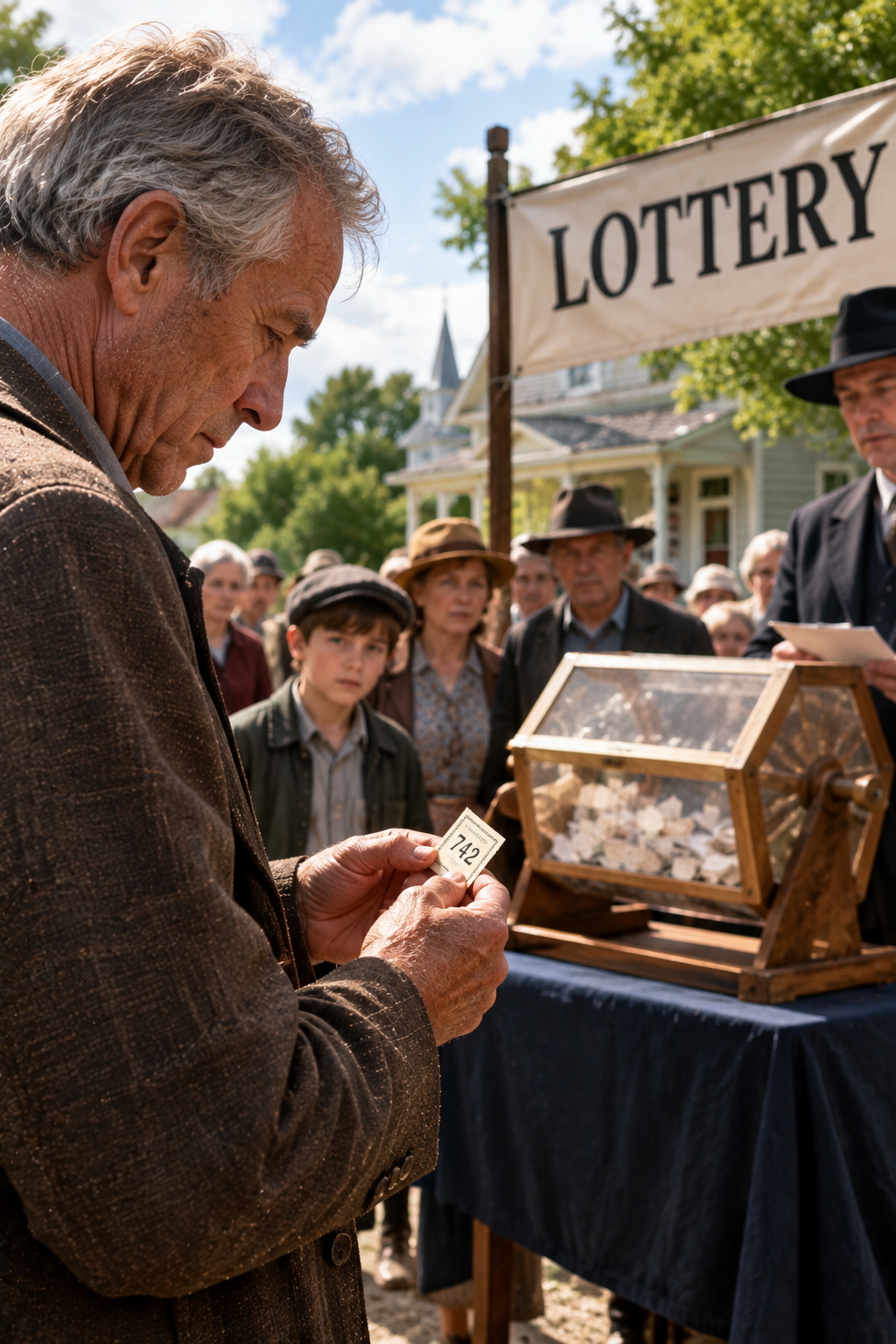
The Announcement in Bellweather
Every year, on the first Saturday of October, the people of Bellweather gathered in the town square for the Harvest Lottery.
It was the oldest tradition in the village.
Nobody knew exactly how it had started. According to the town records, the first lottery had been held almost a century earlier after a terrible winter left dozens of families without food. The town leaders had created a fund to help struggling residents, and over the years the event had grown into something much larger.
Every household received one numbered ticket.
One ticket would be chosen.
The winner would receive enough money to change their life.
People talked about the lottery all year. They discussed lucky numbers, old winners, and strange coincidences surrounding certain tickets.
But this year, something felt different.
The prize was larger than ever before.
And for the first time, the lottery committee had refused to announce where the money had come from.
The Girl With the Blue Envelope
Mara Ellis was twenty-four and worked at the town library.
She had never cared much about the Harvest Lottery. Her father used to joke that their family had been unlucky for generations.
“We couldn’t win a free cup of tea,” he would say.
But this year Mara received something unusual.
Three days before the drawing, she found a blue envelope underneath the library’s front door.
Her name was written on the front.
Inside was a single sentence:
Do not let them draw Ticket 47.
Mara stared at the message.
There was no signature.
She checked the envelope again.
Nothing.
She assumed it was a prank until she remembered something.
Her family’s lottery ticket was number 47.
An Old Secret
Mara immediately visited her grandmother, Eleanor.
The elderly woman lived alone in a small cottage near the river.
When Mara showed her the note, Eleanor’s expression changed.
“Where did you get this?”
“It was left at the library.”
Eleanor sat down slowly.
“You need to listen to me carefully.”
Mara had never seen her grandmother look so frightened.
“The lottery wasn’t always a prize.”
“What do you mean?”
Eleanor glanced toward the window.
“Long ago, the winning ticket didn’t receive money. The winner received ownership of the old water company.”
Mara frowned.
“That doesn’t sound terrible.”
“It wasn’t a gift,” Eleanor said. “It was a responsibility.”
She explained that decades earlier, Bellweather had suffered a drought. The town had created a private water system, and the lottery was used to decide which family would manage it each year.
Eventually, however, the water company became extremely valuable.
Powerful people wanted control of it.
The lottery was changed.
The public was told it was simply a celebration with a cash prize.
But according to Eleanor, certain lottery numbers had been manipulated for years.
Mara looked at the note again.
“Why is Ticket 47 important?”
Her grandmother became silent.
“Because 47 was my father’s number.”
The Missing Ledger
Mara returned to the library and searched through the town archives.
She found newspaper articles about the first lottery, old photographs, committee records, and handwritten meeting notes.
But something was missing.
The original lottery ledger had disappeared.
Without it, nobody could prove that the modern lottery was connected to the old water company.
Mara continued searching.
Near midnight, she found a reference to the ledger in an old librarian’s journal.
The journal contained one strange sentence:
The truth is beneath the clock.
Mara looked toward the large grandfather clock standing in the library’s entrance.
She removed the wooden panel behind it.
A narrow compartment was hidden inside.
There was a book.
The original ledger.
The Names Inside
Mara opened it carefully.
Each page contained a year, a ticket number, and the name of a family.
She noticed something immediately.
Ticket 47 appeared several times.
Her family’s name was written beside it.
So was the name of Eleanor’s father.
And the name of Mara’s great-grandfather.
But the entries were not marked as winners.
They were marked:
Rejected.
Mara turned another page.
The same thing happened repeatedly.
Whenever Ticket 47 was selected, the drawing had supposedly been canceled because of an “administrative error.”
Someone had been preventing her family from winning.
But why?
At the back of the ledger was the answer.
A legal document explained that whoever held the original water rights could challenge the town’s current agreement with a private corporation.
Ticket 47 represented the original Ellis claim.
Mara suddenly understood.
The lottery was not just about money.
Someone wanted to make sure Ticket 47 never became important again.
The Night of the Drawing
The town square was packed on Saturday evening.
Thousands of lights decorated the buildings.
A band played near the fountain.
Children ran between the food stalls.
On the stage stood the lottery committee.
Mara watched from the crowd with the ledger hidden inside her coat.
At exactly eight o’clock, the mayor stepped forward.
“Tonight, one family will receive the largest Harvest Lottery prize in Bellweather history.”
Applause filled the square.
The mayor reached toward the glass drum.
Mara noticed something.
The drum had been replaced.
The old wooden lottery box shown in historical photographs was nowhere to be seen.
Then the mayor announced:
“Ticket 47 has been selected.”
The crowd went silent.
Mara felt her heart pounding.
For years, her family had been told that their number was unlucky.
But now it had been chosen.
The mayor smiled.
“Unfortunately, there appears to be a problem.”
Mara stepped forward.
“No.”
Everyone turned.
She walked toward the stage.
“There is no problem with Ticket 47.”
The mayor’s face changed.
Mara removed the old ledger from her coat.
“I found the original records.”
The Truth Revealed
The crowd gathered around her.
Mara explained everything.
She showed them the repeated cancellations of Ticket 47 and the documents concerning the water rights.
The mayor tried to interrupt.
“These are old records. They have no legal meaning.”
“Then why were they hidden?”
Nobody answered.
Eleanor stepped out of the crowd.
She held another document.
“My father kept this.”
She handed it to a lawyer standing nearby.
The lawyer read it carefully.
Then he looked at the mayor.
“This changes everything.”
People began talking among themselves.
Several older residents admitted that their families had heard stories about the lottery being manipulated.
Others demanded that the town council investigate.
Within hours, the drawing was suspended.
The money was placed into a protected account.
And the water company records were taken for an independent investigation.
A Different Kind of Winner
Weeks later, the investigation confirmed that the lottery had been manipulated in the past.
The town’s water rights were also found to have been transferred under questionable circumstances decades earlier.
Nobody in Bellweather received the enormous prize that year.
Instead, the money was placed into a community fund.
The fund helped repair the town’s aging water system and supported families struggling with rising living costs.
Mara’s family did not become wealthy.
But they received something more valuable.
Their name was finally cleared.
Eleanor framed a copy of the original ledger and placed it in the library.
Underneath it, she wrote a simple sentence:
A tradition is worth keeping only when its purpose is remembered.
The Next Lottery
The following year, Bellweather held the Harvest Lottery again.
There was a new committee.
The rules were published publicly.
Every ticket was checked by independent observers.
And the old wooden lottery box was brought back.
Mara stood beside the stage as the first ticket was drawn.
This time, nobody was afraid of the number.
There was no secret waiting behind it.
No hidden agreement.
No family being pushed aside.
Just a town celebrating together.
Eleanor stood in the front row.
She smiled at Mara.
“Are you going to buy a ticket?”
Mara laughed.
“I think I’ve had enough lotteries for one lifetime.”
The crowd laughed with her.
Then the winning number was announced.
It was not 47.
And for the first time, nobody cared.
The people of Bellweather had finally learned that the greatest prize was not the money inside a lottery box.
It was knowing that the rules were fair.
Conclusion
The lottery in Bellweather began as a tradition meant to bring people together, but forgotten secrets gradually turned it into something very different. Mara’s discovery shows how important it is to question traditions when nobody can explain their purpose or rules. Sometimes, the most valuable prize is not wealth at all—it is truth, fairness, and the courage to uncover what has been hidden.