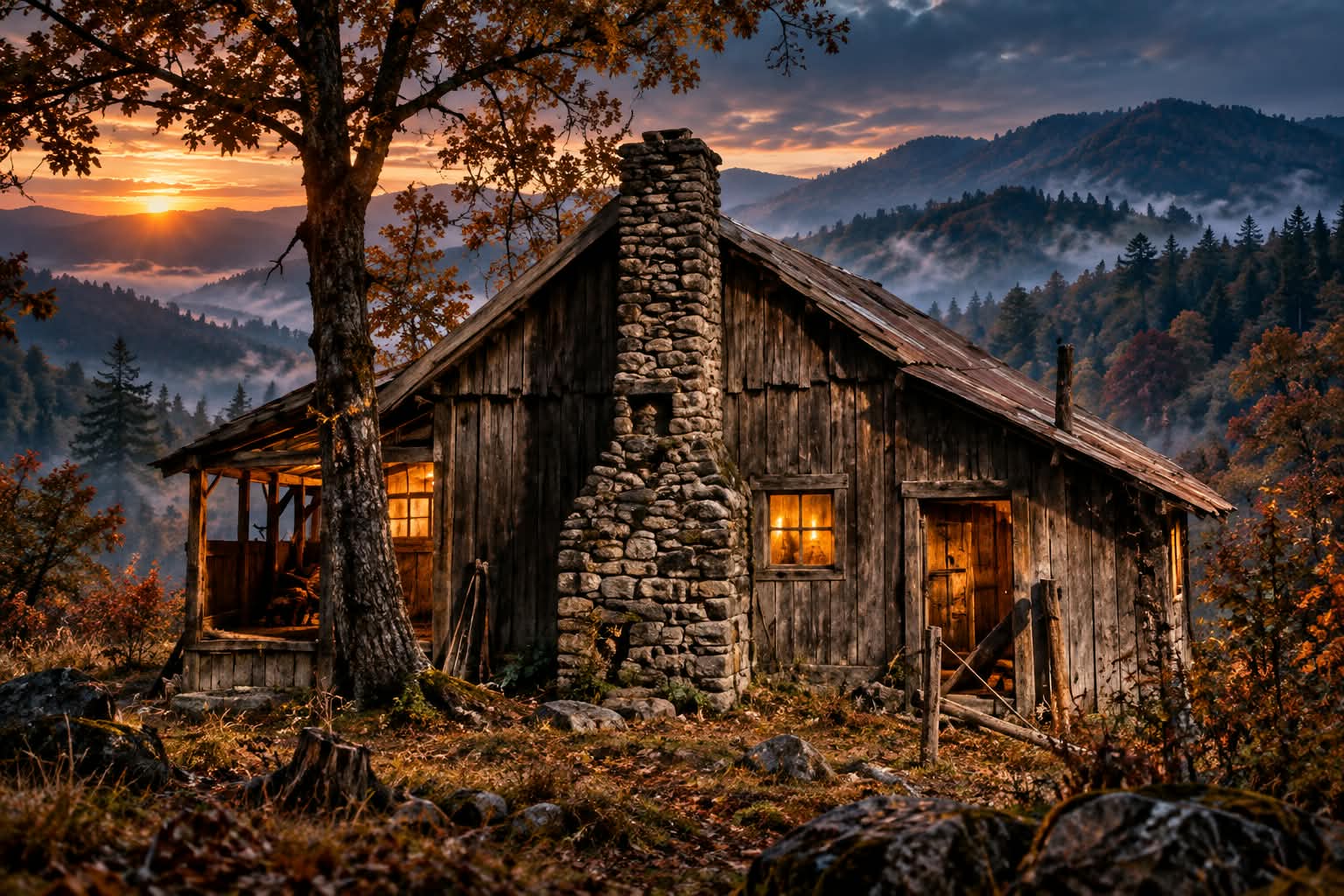
For seventy-three years, Samuel Whitmore lived in a wooden cabin hidden deep in the Appalachian Mountains. He had never driven a car, entered a supermarket, watched television, or slept anywhere beyond the valley where he was born.
To the outside world, Samuel was almost a legend.
But to Samuel, the outside world had never been necessary.
The Seventh Son
Samuel was born in the winter of 1932, during one of the coldest seasons the mountain community could remember.
His parents had already buried six infant sons. When Samuel arrived, his mother refused to celebrate until he survived his first winter.
She kept him beside the fireplace, wrapped in handmade blankets, whispering prayers whenever the wind rattled the cabin walls.
Somehow, he survived.
His father called him their miracle.
As Samuel grew older, he learned to survive in the wilderness. He could identify approaching storms by watching the birds, find drinking water beneath frozen ground, and build a fire in the rain.
His father taught him everything except how to leave.
A World Beyond the Trees
By the time Samuel turned twenty, electricity had reached nearby towns. Families were purchasing radios, refrigerators, and automobiles.
Samuel knew these inventions existed, but he had little interest in them.
His mother died when he was twenty-seven. His father followed three winters later.
After their deaths, Samuel remained alone in the cabin.
He planted potatoes, collected rainwater, chopped firewood, and repaired his clothes by hand.
Occasionally, neighbours left flour or medicine near his gate.
He always returned the kindness with vegetables or jars of honey.
People asked why he never visited town.
Samuel would smile.
“Everything I love is already here.”
The Winter Everything Changed
In December 2005, a violent snowstorm swept across the valley.
Samuel was chopping wood when a sharp pain spread through his chest. He fell to his knees, struggling to breathe.
A neighbour discovered him the following morning and called an ambulance.
Samuel resisted when the paramedics tried to move him.
He had never ridden in a motor vehicle.
The ambulance frightened him more than the pain.
But eventually, he agreed.
As the vehicle travelled down the mountain, Samuel pressed his hand against the window.
He watched telephone poles, shops, traffic lights, and buildings pass by.
For the first time, he understood how much the world had changed.
The Moving Pictures
At the hospital, Samuel noticed a television mounted on the wall.
A documentary showed snowy mountains, wild deer, and a wooden cabin beside a river.
Samuel stared at the screen.
“How did they put a mountain inside that box?” he whispered.
A nurse gently explained television.
Samuel watched in silence.
Then the programme changed to footage of astronauts walking on the Moon.
His eyes filled with tears.
“People have walked up there?”
The nurse nodded.
Samuel looked toward the hospital window.
All his life, he had believed the mountain was the biggest world a man could know.
Now he realised that people had travelled beyond the sky.
The Last Wish
Samuel remained in hospital for several days, but his condition worsened.
When the doctor asked whether he wanted anything, Samuel requested one thing.
“Please take me home.”
The hospital arranged his return.
He spent his final evening beside the fireplace, listening to the wind moving through the trees.
A neighbour asked whether he regretted never seeing the wider world.
Samuel thought for a moment.
“I saw the seasons change seventy-three times. I watched the stars without city lights. I knew every bird that sang outside my window.”
He smiled.
“Maybe I didn’t miss as much as people think.”
Samuel died peacefully that night.
Years later, visitors discovered a handwritten sentence inside his cabin.
“A small world can still hold a beautiful life.”
Story 2: The Cabin That Was Never Empty — A Mountain Mystery
Nobody in Black Hollow could explain why the lights appeared inside Elijah Crowe’s abandoned cabin every winter.
The cabin had stood empty for nearly twenty years.
Its owner had died in a hospital miles away.
There was no electricity, no working fireplace, and no road leading directly to the property.
Yet every December, just after midnight, someone seemed to be living inside.
The Man Nobody Understood
Elijah Crowe was born in 1928, the youngest of seven sons.
His six older brothers died before reaching their first birthdays.
His mother believed the mountain had spared Elijah for a reason.
She raised him in isolation, warning him that the valley beyond the trees was dangerous.
Elijah never attended school.
He learned to read from an old Bible and measured time by the changing seasons.
When his parents died, he stayed in the cabin.
He rarely spoke to strangers.
But the people who occasionally visited noticed something unusual.
Elijah always placed seven wooden chairs around his dining table.
Even though he lived alone.
The Seven Chairs
In 1979, a young forestry worker named Daniel Price visited Elijah to check the condition of the surrounding woodland.
Inside the cabin, Daniel noticed six small chairs and one large chair.
“Do you have visitors?” Daniel asked.
Elijah shook his head.
“Not the kind you can see.”
Daniel laughed nervously.
Elijah didn’t.
He explained that his mother had always told him his brothers were watching over him.
Every evening, he set the table for seven.
Daniel assumed the old man was lonely.
But before leaving, he noticed something unsettling.
Six small wooden cups were arranged neatly on the table.
All six contained fresh water.
The Final Journey
In 1998, Elijah became seriously ill.
Neighbours convinced him to visit a hospital.
It was the first time he had travelled in a car.
At the hospital, he saw television for the first time.
A news programme showed busy streets, aeroplanes, and enormous cities.
Elijah watched without speaking.
Then the screen suddenly displayed an old black-and-white photograph of seven children standing outside a farmhouse.
Elijah grabbed the nurse’s wrist.
“That’s my house.”
The nurse looked at the screen.
It was a documentary about forgotten mountain communities.
The photograph disappeared before anyone could identify it.
Elijah died three days later.
His cabin was locked.
Twenty Years Later
In December 2018, a photographer named Claire Bennett arrived in Black Hollow to document abandoned mountain homes.
Local residents warned her not to enter Elijah’s cabin after sunset.
Claire dismissed the stories.
She reached the property just before dusk.
Inside, everything was covered in dust.
Except the dining table.
Seven chairs stood around it.
Six small cups contained clear water.
Claire photographed the scene.
Then she heard footsteps upstairs.
“Hello?” she called.
No answer.
The footsteps continued.
Slowly, Claire climbed the staircase.
At the end of the hallway stood a closed bedroom door.
From behind it came the sound of children laughing.
Claire froze.
The laughter stopped.
A quiet voice whispered:
“He’s finally home.”
The Photograph
Claire ran from the cabin.
Back at her hotel, she reviewed the photographs on her camera.
The dining room image showed seven chairs.
But something had changed.
In the photograph, six small figures appeared seated around the table.
Their faces were blurred.
At the head of the table sat an elderly man wearing a dark hat.
Claire enlarged the picture.
The man was smiling directly at the camera.
The next morning, she returned with a local police officer.
The cabin was empty.
The chairs were covered in dust.
The cups were dry.
But on the table lay a photograph Claire had never seen before.
It showed seven brothers standing together outside the cabin.
On the back, someone had written:
“No one who belongs here is ever truly alone.”
Claire never returned to Black Hollow.
And every December, the lights still appear.
Story 3: The Man Who Saw the Future on Television — A Forgotten Mountain Secret
When eighty-year-old Thomas Bell watched television for the first time, he didn’t ask how the machine worked.
He didn’t marvel at aeroplanes, skyscrapers, or people walking on the Moon.
Instead, he pointed at the screen and said something that made the hospital nurse turn pale.
“I’ve seen that place before.”
The problem was that Thomas had never left his mountain.
A Childhood Without the Outside World
Thomas was born in 1926 in a remote mountain settlement called Willow Creek.
He was the seventh child in his family, but the only one who survived infancy.
His parents lived without electricity or running water.
They grew their own food and rarely travelled beyond the forest.
Thomas learned to hunt, fish, repair tools, and navigate the mountains by observing the stars.
He had never visited a school, seen a train, or entered a town.
When his parents died, he continued living exactly as they had.
Years passed.
Roads appeared beyond the valley.
Factories opened.
New generations grew up with radios, televisions, and eventually computers.
Thomas remained in his cabin.
The Strange Drawings
As a child, Thomas had a peculiar habit.
He drew pictures of places he claimed to see in dreams.
His notebooks contained enormous buildings made of glass, metal birds flying above cities, and strange vehicles moving without horses.
His mother called them imagination.
His father thought they were nonsense.
But Thomas continued drawing.
By his sixtieth birthday, he had filled twelve notebooks.
One drawing showed a tall silver building beside a river.
Another depicted a bridge illuminated by thousands of lights.
A third showed people holding small glowing rectangles in their hands.
Thomas had no explanation for any of them.
He simply said:
“Sometimes I dream about places I haven’t been.”
The Hospital Room
In 2006, Thomas suffered a severe infection.
A local volunteer discovered him unconscious near his fireplace.
An ambulance carried him to the nearest hospital.
When Thomas regained consciousness, he was surrounded by machines.
The nurse explained where he was.
He listened quietly.
Then he noticed a television mounted on the wall.
A travel programme was showing New York City.
Thomas stared.
The screen displayed skyscrapers, bridges, crowded streets, and bright advertisements.
His breathing quickened.
“Stop that picture,” he whispered.
The nurse thought he was frightened.
But Thomas pointed toward the screen.
“That building. I drew it when I was twelve.”
The Notebook
The nurse, named Rebecca, contacted the volunteer who had brought Thomas to hospital.
She asked whether any drawings existed inside his cabin.
Two days later, the volunteer returned with an old leather notebook.
Rebecca opened it.
The first pages contained sketches of trees, rivers, and mountain animals.
Then she reached a drawing of a large suspension bridge.
It resembled the Brooklyn Bridge.
Another page showed a city skyline.
Several buildings looked strikingly similar to those on the television.
Rebecca was fascinated.
Thomas insisted he had never seen photographs of those places.
But one drawing troubled her more than the others.
It showed a hospital room.
A bed stood beside a window.
A television hung on the wall.
And an elderly man lay beneath a white blanket.
At the bottom of the page, written in faded pencil, were the words:
“THE LAST JOURNEY.”
The Date Nobody Could Explain
Rebecca examined the drawing carefully.
The hospital room looked remarkably similar to Thomas’s own.
Even the television was positioned in the same corner.
Then she noticed a date beneath the sketch.
October 19, 2006.
That was four days away.
Rebecca showed Thomas the page.
He studied it without surprise.
“I wondered when I’d get here,” he said.
“How could you have drawn this?”
Thomas looked toward the mountains visible through the hospital window.
“Maybe dreams are memories from somewhere we haven’t reached yet.”
Rebecca didn’t know what to say.
The Last Four Days
Over the next few days, Thomas asked questions about the modern world.
He learned about satellites, mobile phones, space travel, and the internet.
He watched documentaries about oceans, deserts, and distant countries.
Every evening, Rebecca sat beside him.
Thomas seemed less interested in technology than in the people using it.
He watched families embracing at airports.
Children playing in parks.
Couples walking beside the sea.
One evening, he whispered:
“The world is bigger than I thought.”
Rebecca smiled.
“It is.”
Thomas looked down at his hands.
“But people are still looking for the same things.”
“What things?”
“Someone to love. Somewhere to belong. A reason to wake up tomorrow.”
The Final Drawing
On October 19, Rebecca arrived for her morning shift.
Thomas had died peacefully during the night.
Beside his bed lay the leather notebook.
It was open to the drawing of the hospital room.
Rebecca turned the page.
There was one final sketch she hadn’t noticed before.
It showed a small wooden cabin surrounded by mountains.
Seven figures stood outside beneath a clear sky.
One was an elderly man wearing a dark hat.
The other six appeared to be young boys.
Underneath, Thomas had written:
“Every journey ends somewhere. Perhaps mine ends where theirs began.”
Rebecca kept a copy of the drawing for years.
She never discovered whether Thomas had truly dreamed of the future or simply possessed an extraordinary imagination.
But she never forgot what he told her on his final evening.
“You don’t have to see the whole world to understand what matters in it.”
All three are fictional stories, not verified accounts of the person in the photograph. They are independently written with different plots:
- Story 1: Emotional, inspirational, and heartwarming.
- Story 2: Supernatural mystery and atmospheric horror.
- Story 3: Mysterious, thought-provoking, and emotional.