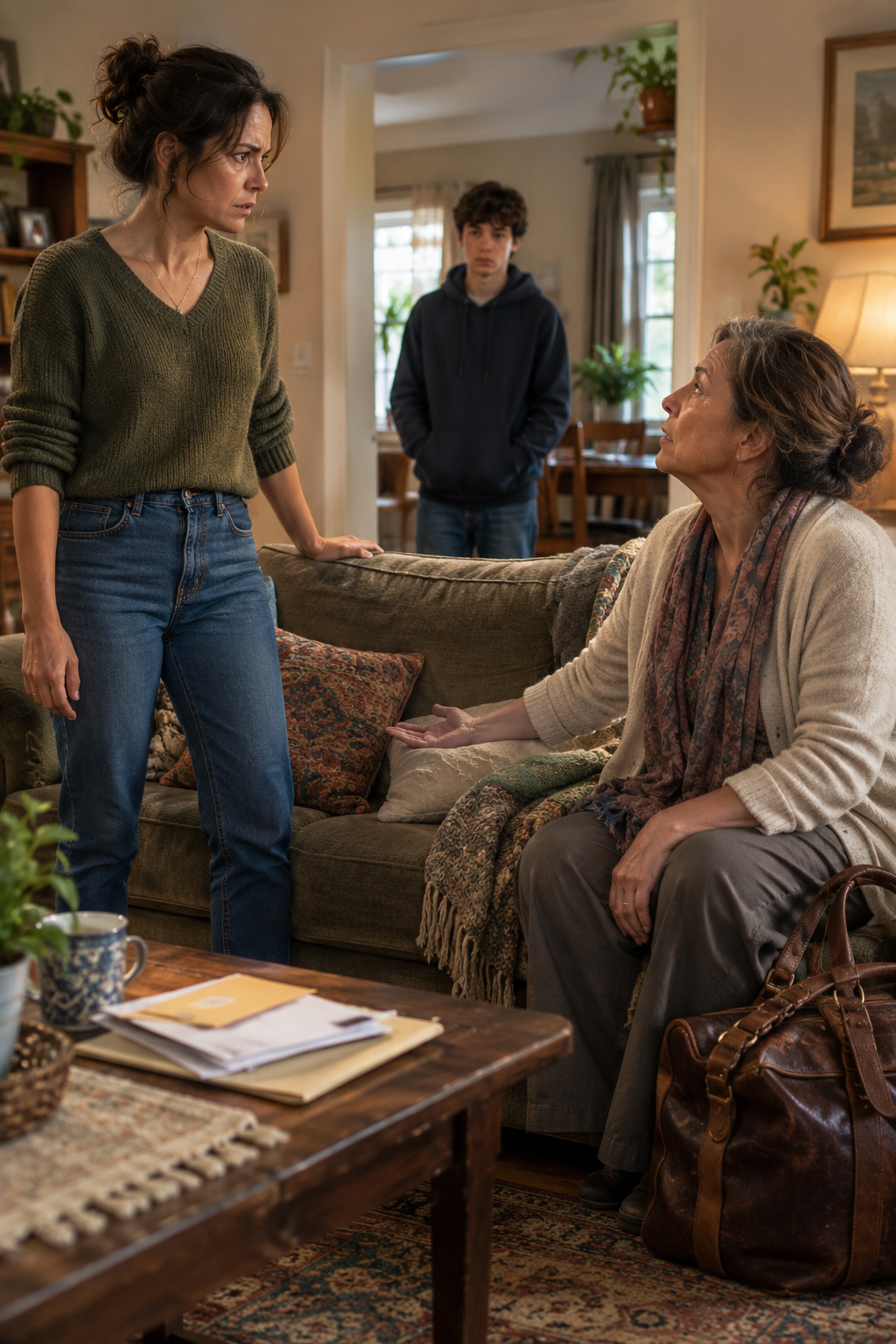
The Woman at My Door
The knock came at 8:17 on a rainy Tuesday evening.
I almost ignored it.
At thirty-one, I had learned not to open my door for unexpected visitors, especially after dark. But something about the knock was different. Three slow taps, a pause, then two more.
When I opened the door, I forgot how to breathe.
The woman standing beneath my porch light was older than the mother I remembered.
Her hair was streaked with gray. Her face was thinner. She wore a faded brown coat and held a small canvas bag against her chest.
But I knew her eyes.
My mother had left when I was twelve.
She had never called.
Never written.
Never sent a birthday card.
For nineteen years, I had wondered whether she was alive.
Now she was standing in front of me.
“Evan,” she whispered.
Nobody had said my name that way in years.
I gripped the doorframe.
“Mom?”
She nodded.
Then, after nineteen years of silence, she looked past me into my apartment.
“I need something,” she said.
I expected an apology.
Instead, she asked the strangest question I had ever heard.
“Do you still have the old couch?”
The Couch She Left Behind
The couch was almost twenty years old.
It had belonged to my grandmother before my mother brought it into our house. It was ugly even then—dark green fabric, wooden arms, and a tear beneath the left cushion.
When my mother disappeared, the couch was one of the few things she left behind.
My father had wanted to throw it away.
I had refused.
As a child, I couldn’t explain why.
I just couldn’t let him take it.
Years later, when I moved into my own apartment, I took the couch with me.
It became more than furniture.
It was a piece of the childhood I couldn’t remember without feeling angry.
I stared at my mother.
“Yes,” I said slowly. “I still have it.”
Her shoulders relaxed.
“Can I see it?”
I stepped aside.
She walked into the apartment like someone entering a house she had once owned.
When she saw the couch, she stopped.
For several seconds, she didn’t move.
Then she touched the torn fabric beneath the cushion.
“You kept it,” she whispered.
“Why do you care about a couch?”
She looked at me.
“Because your father told me he destroyed it.”
Nineteen Years of Silence
I felt a coldness spread through my chest.
“My father said you left.”
“I didn’t.”
The words were so quiet I almost missed them.
“What?”
She sat down carefully.
“I didn’t leave you.”
I laughed, but there was no humor in it.
“Mom, you disappeared for nineteen years.”
“I know.”
“You didn’t call.”
“I know.”
“You didn’t write.”
“I tried.”
My anger returned immediately.
“If you tried, why didn’t I get anything?”
She looked toward the window.
“Because your father made sure you didn’t.”
I wanted to believe her.
That was the problem.
Some part of me had spent nineteen years wanting exactly this explanation.
But another part had learned not to trust anyone.
“Where were you?”
She opened her canvas bag.
Inside was a small metal box.
“I was trying to come back.”
She placed the box on the coffee table.
“Your father found out.”
The Hidden Compartment
My mother pointed toward the couch.
“Turn it over.”
I stared at her.
“Why?”
“Because your grandmother showed me something before she died.”
I knelt beside the couch.
Together, we moved it away from the wall.
My mother pointed underneath the wooden frame.
“There’s a loose panel.”
I ran my fingers across the bottom.
At first, I felt nothing.
Then my thumb caught a small wooden edge.
I pulled.
A narrow panel popped open.
Behind it was a dusty compartment.
My heart began pounding.
Inside was a sealed envelope.
My name was written on it.
EVAN — WHEN YOU ARE OLD ENOUGH TO UNDERSTAND.
The handwriting was my grandmother’s.
My mother closed her eyes.
“I thought it was gone.”
I carefully opened the envelope.
Inside were several photographs, handwritten letters, and a small key.
The first photograph showed my mother holding me as a baby.
The second showed my father standing beside her.
But the third photograph made my hands shake.
It showed my father talking to another man outside a motel.
On the back, my grandmother had written:
He knows where she is.
The Truth My Family Buried
I looked at my mother.
“Who is that man?”
“My father’s business partner,” she said.
I frowned.
“My father never had a business partner.”
“He did. Before you were born.”
She explained that my father had been involved in a financial scheme that eventually collapsed. Money disappeared. People blamed him.
My mother discovered what was happening and threatened to report him.
That was when everything changed.
My father told her that if she went to the police, he would make sure she never saw me again.
She didn’t believe him.
Until one night, she came home and found the house empty.
I had been taken to my aunt’s house.
My mother went to look for me.
When she returned, my father was gone.
So was most of their money.
She went to the police.
But my father had already filed a different story.
According to his version, my mother had abandoned her family.
The documents supported him.
My mother was devastated.
“I tried to fight,” she said. “But I had no money, no lawyer, and no idea where you were.”
She eventually left town.
For years, she searched from a distance.
But she was afraid that returning too soon would put me in danger.
“Why come back now?”
She looked at the metal box.
“Because I finally found the proof.”
The Key
I picked up the small key from the envelope.
“What does this open?”
My mother smiled sadly.
“That’s why I came for the couch.”
She explained that my grandmother had hidden something inside it long before she died.
Not just the letters.
A second envelope.
She believed my father had searched the house after my mother disappeared, but he had never discovered the hidden compartment.
The second envelope contained an address.
A storage facility across town.
We went there the following morning.
Inside one of the old lockers was a cardboard box.
It contained bank records, photographs, copies of letters, and a recording.
My father’s voice.
He was admitting everything.
He admitted lying about my mother.
He admitted intercepting her letters.
He even admitted paying someone to make sure she stayed away.
For nineteen years, I had believed my mother abandoned me.
The truth was worse.
She had been trying to reach me the entire time.
Why She Really Wanted the Couch
We returned to my apartment that evening.
My mother stood beside the old couch.
“I don’t actually want the couch,” she said.
I looked at her.
“Then why did you ask for it?”
She smiled.
“Because I needed to know whether you had kept it.”
“Why?”
“Because if you had, I knew there was still a chance you remembered something.”
I frowned.
“What?”
She pointed beneath the left armrest.
“There.”
I felt around the wooden frame.
My fingers found a tiny carved mark.
Three lines.
I suddenly remembered.
When I was six, my mother had shown me the mark.
She told me it was our secret sign.
“If you ever feel lost,” she had said, “look for three lines. I’ll know where you are.”
I had forgotten.
Until that moment.
My mother began crying.
So did I.
For the first time in nineteen years, neither of us tried to hide it.
A Different Kind of Reunion
The investigation eventually confirmed much of what my mother had told me.
My father had disappeared years earlier, and the financial case surrounding him had long since gone cold.
But the evidence changed everything.
My mother didn’t ask for money.
She didn’t ask me to forgive her.
She didn’t even ask to move in.
She simply wanted a chance to know her son.
And strangely, I wanted the same thing.
Our relationship wasn’t magically repaired.
Nineteen years cannot disappear because of one conversation.
There were questions we still had to answer.
There were birthdays she had missed.
School events she never attended.
Christmas mornings she knew only through imagination.
But there was one thing we finally had.
Time.
The Couch Stayed
My mother never took the couch.
She said it belonged with me.
Months later, I had it professionally repaired.
The torn fabric was replaced, but I asked the upholsterer to leave the small carved mark beneath the armrest untouched.
Three lines.
Our secret sign.
My mother visits every Sunday now.
Sometimes we talk for hours.
Sometimes we sit silently and watch television.
And sometimes she tells me stories about the little boy I was before everything changed.
The couch remains in my living room.
It is still old.
Still ugly.
Still slightly crooked.
But now I understand why I could never throw it away.
I thought I had been holding on to a piece of my childhood.
I was wrong.
All those years, I had been holding on to a message my mother had left behind.
A message that simply said:
I never stopped looking for you.
And after nineteen years, I finally knew the truth.
She hadn’t come back for the couch.
She had come back for me.