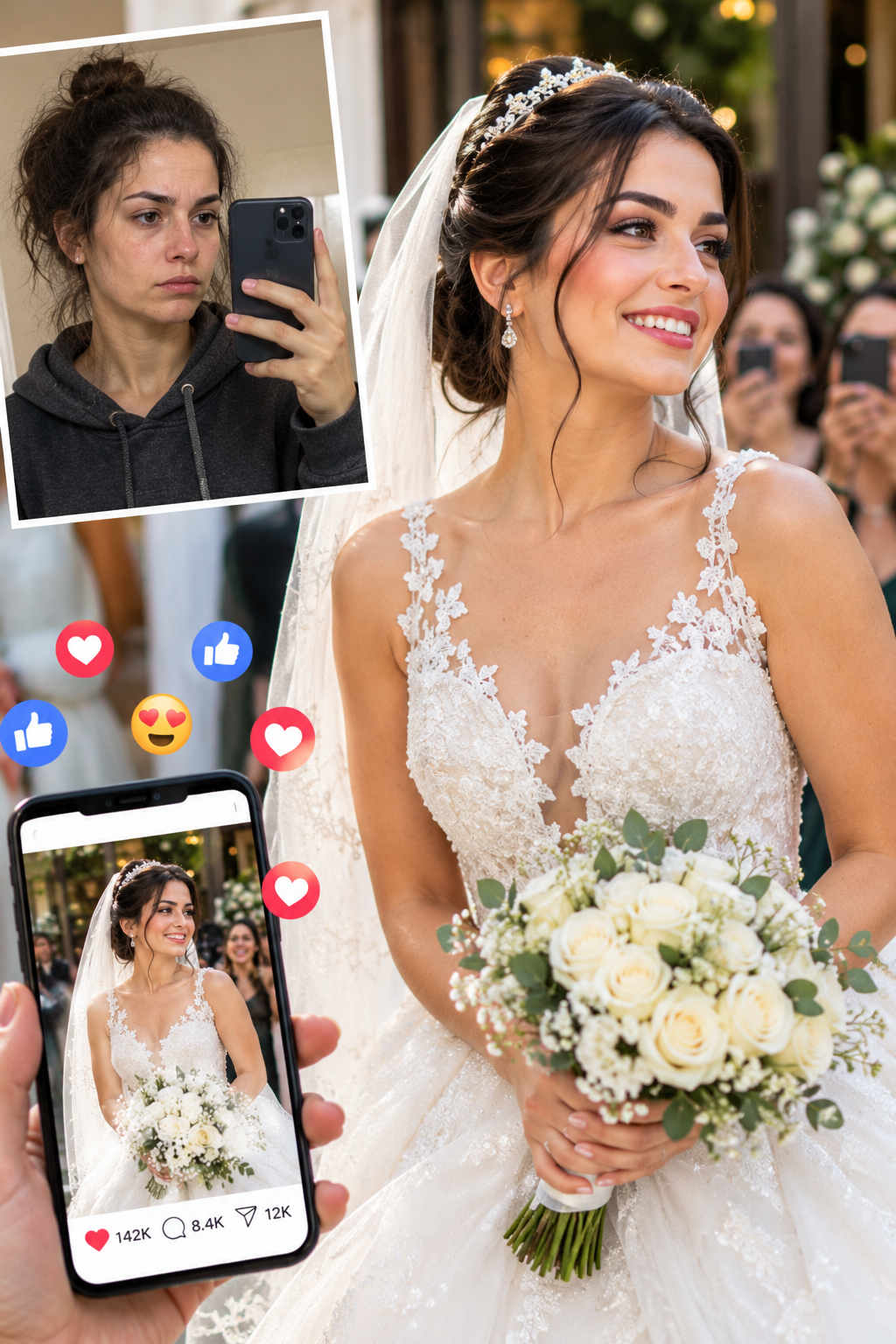
When the bride stepped into the wedding hall, hundreds of phones immediately turned toward her.
She looked nothing like the woman her family had watched getting ready that morning.
Within hours, photographs of her transformation were everywhere. Thousands of people praised her appearance. Others called it inspiring. A few claimed it was the most beautiful bridal transformation they had ever seen.
But the celebration didn’t last.
By the following evening, the same photographs had become the center of a fierce online argument about culture, tradition, family expectations, and how much a bride should be willing to change for her wedding day.
And at the center of the controversy was a woman named Maya, who had never expected her wedding to become a national conversation.
The Bride Everyone Thought They Knew
Maya had always been different from the women in her family.
She loved her culture, respected her parents, and participated in family traditions. But she also believed traditions should leave room for personal choice.
Her grandmother disagreed.
To her grandmother, a wedding wasn’t simply a celebration. It was a bridge between generations.
“Your wedding day is the one day when the whole family stands behind you,” she often told Maya. “Don’t forget where you came from.”
Maya understood the sentiment.
What she didn’t understand was why remembering where she came from had to mean becoming someone she wasn’t.
Her wedding was scheduled for a warm Saturday evening in early summer.
The venue had been decorated for weeks. Traditional flowers covered the entrance, musicians had been booked, and relatives had traveled from different cities.
Everything seemed perfect.
Until Maya looked into the mirror that morning.
The Secret Behind the Mirror
Maya had spent months planning her wedding appearance.
She wanted something elegant but traditional enough to make her family happy.
Yet when her makeup artist arrived, Maya quietly asked her for something completely different.
“Can you make me look like myself?” she asked.
The makeup artist smiled.
“Of course.”
But Maya wasn’t talking about makeup.
She wanted to remove the heavy styling everyone had expected. She wanted her natural features to remain visible. She wanted a simpler hairstyle and a modern interpretation of the traditional bridal clothing.
Most importantly, she wanted to feel like herself.
Her mother initially objected.
“Maya, everyone will be expecting the traditional look.”
“I know.”
“Your grandmother won’t understand.”
“I know that too.”
Her mother stared at her for several seconds.
Then she sighed.
“Just don’t regret this.”
Maya smiled.
“I won’t.”
Neither of them knew that the decision would soon become the most controversial part of the wedding.
The Transformation
By afternoon, Maya’s transformation was complete.
She wore a traditional outfit, but it had been styled in a way nobody in her family had seen before.
The colors were softer.
The jewelry was lighter.
Her hairstyle was simple.
Her makeup highlighted rather than concealed her natural features.
Instead of trying to become a perfect version of a traditional bride, Maya looked like a modern woman carrying her heritage with her.
When she entered the room where her family was waiting, everyone became silent.
Her younger sister was the first to speak.
“Wow.”
Maya laughed nervously.
“Is that good wow or bad wow?”
“Very good wow.”
Then her grandmother walked into the room.
Maya’s smile disappeared.
The elderly woman looked at her from head to toe.
She said nothing.
For several uncomfortable seconds, nobody moved.
Finally, her grandmother approached her.
“You look beautiful,” she said.
Maya exhaled.
“Thank you.”
But there was something unusual in her grandmother’s expression.
It wasn’t anger.
It was uncertainty.
As if she had just seen the future arrive earlier than she expected.
The Photograph That Changed Everything
During the ceremony, a photographer captured a photograph of Maya standing beside her grandmother.
In the picture, Maya was smiling.
Her grandmother wasn’t.
But the older woman’s hand was firmly holding Maya’s.
The photographer posted the photograph online after receiving permission from the family.
Nobody expected what happened next.
Within a few hours, the photograph spread rapidly across social media.
People praised Maya’s appearance.
Comments appeared by the thousands.
Some called her transformation beautiful.
Others admired the way she had blended tradition with modern fashion.
Then someone posted a longer message.
They accused Maya of disrespecting cultural traditions.
That message was shared repeatedly.
Soon, the conversation changed.
When Praise Turned Into Backlash
The viral photograph was no longer simply a wedding picture.
It had become a debate.
One side argued that culture should evolve.
Another insisted that certain traditions should remain untouched.
Some people criticized Maya personally.
Others criticized her family for allowing the change.
Then strangers began making assumptions about her grandmother.
“She must be heartbroken.”
“She probably wanted a traditional bride.”
“The younger generation has no respect anymore.”
Maya read the comments late that night.
At first, she laughed.
Then she became uncomfortable.
By midnight, she had stopped laughing.
She put her phone down.
Her husband, Daniel, noticed.
“What happened?”
She showed him the screen.
Daniel read several comments.
“You don’t have to answer them.”
“I know.”
“Then don’t.”
Maya looked at him.
“What if they’re right?”
Daniel paused.
“About what?”
“What if I really did disrespect my family?”
Daniel reached for her hand.
“Your family was standing beside you when you walked down the aisle.”
Maya looked away.
“That doesn’t mean everyone was happy.”
“No,” Daniel said. “But it means they chose to be there.”
The Question Nobody Asked
The next morning, Maya’s mother received dozens of messages.
Some relatives were upset.
Others defended Maya.
One aunt accused the family of allowing “tradition to disappear.”
Another relative said Maya had simply found a beautiful way to make the tradition her own.
The family group chat became chaotic.
But Maya’s grandmother remained silent.
That silence frightened Maya more than the angry comments.
Finally, she went to visit her.
Her grandmother was sitting beside a window, looking through an old wooden box.
“Maya,” she said without looking up.
“Yes?”
“Come here.”
Maya sat beside her.
The old woman opened the box.
Inside were photographs.
Black-and-white photographs.
Wedding photographs.
Family photographs.
Photographs of women Maya had never met.
Her grandmother handed her one.
“This was my wedding day.”
Maya looked at the picture.
Her grandmother was young.
She wore a traditional wedding outfit.
Her hair was styled exactly as tradition demanded.
But there was something else.
She was barely smiling.
Maya looked at her.
“You weren’t happy?”
Her grandmother laughed softly.
“I was happy to be married.”
“That isn’t what I asked.”
The old woman’s smile disappeared.
“No,” she said. “I wasn’t happy with everything.”
The Secret Her Grandmother Had Kept
Maya listened as her grandmother revealed something she had never told anyone.
On her wedding day, she had wanted to wear a different style.
She had wanted a simpler dress.
She had wanted to cut her hair shorter.
She had even wanted to remove some of the jewelry.
But her own mother had refused.
“She told me that a bride doesn’t belong to herself on her wedding day,” her grandmother said.
Maya stared at her.
“What happened?”
“I obeyed.”
“Do you regret it?”
Her grandmother looked toward the window.
“I regretted believing that obedience was the same thing as love.”
Maya’s eyes filled with tears.
“Then why were you upset with me?”
“I wasn’t upset because you changed the tradition.”
Her grandmother reached for Maya’s hand.
“I was afraid you would forget it completely.”
Maya squeezed her hand.
“I don’t want to forget it.”
“Then don’t.”
The Meaning Behind the Viral Photograph
Maya finally understood the expression on her grandmother’s face in the photograph.
It wasn’t disappointment.
It was recognition.
Her grandmother had seen herself in Maya.
The difference was that Maya had been given something she had never received.
A choice.
That afternoon, Maya asked her grandmother for permission to share the story.
The older woman agreed.
Maya recorded a short video explaining what had happened.
She didn’t attack the people criticizing her.
She didn’t insult tradition.
She simply explained that culture was not something she wanted to abandon.
It was something she wanted to carry forward.
But she wanted to carry it willingly.
The video spread even faster than the wedding photograph.
The Backlash Takes Another Turn
Something unexpected happened.
People who had criticized Maya began sharing stories from their own families.
A woman wrote about being forced to wear a wedding outfit she hated.
Another described being pressured into following traditions she didn’t understand.
Someone else defended traditional customs and explained why they mattered deeply to their family.
The argument didn’t disappear.
It became more complicated.
And perhaps that was the point.
Culture was no longer being discussed as something that was simply right or wrong.
People were finally talking about why traditions mattered—and when they could change.
A Wedding That Became Something Bigger
Weeks later, Maya returned to the same venue for a family gathering.
Her grandmother arrived wearing a modern shawl over her traditional clothing.
Maya noticed immediately.
“You changed your style,” she teased.
Her grandmother smiled.
“Apparently, I am allowed to.”
They both laughed.
Maya’s mother watched them from across the room.
She smiled too.
The viral photograph eventually disappeared from people’s feeds.
New stories replaced it.
New controversies took its place.
But inside Maya’s family, the photograph remained on the wall.
Not because Maya looked beautiful.
Not because it became famous.
But because it captured something far more important.
A grandmother holding the hand of a granddaughter who had chosen to honor tradition without surrendering her identity.
The Real Transformation
Maya’s wedding transformation had attracted millions of views, but her appearance wasn’t the most important change that happened that day.
The real transformation happened inside her family.
A grandmother discovered that tradition could survive without controlling the next generation.
A mother learned that protecting culture didn’t always mean protecting every old rule.
And Maya learned that honoring your roots doesn’t require you to stop growing.
Traditions are often described as bridges between the past and the future.
But a bridge isn’t meant to trap people on either side.
It is meant to help them cross.
And sometimes, the strongest way to honor where you came from is to carry its best parts forward while having the courage to change the rest.
Maya’s wedding became famous because people thought they were looking at a dramatic transformation.
In reality, they were looking at something much deeper.
A family learning that love and tradition can coexist with choice.
And that may have been the most beautiful transformation of all.